If you’ve priced a RAM upgrade lately, you’ve probably done a double take. A 32GB DDR5 kit that once sold for around $72 cost close to $480 at the cheapest retailers in early November 2026.
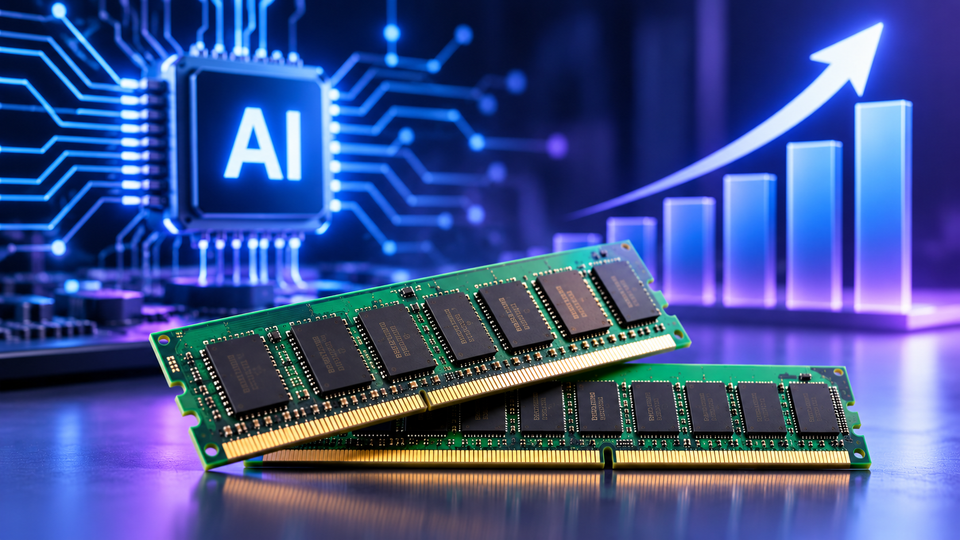
RAM, or computer memory, is where your processor’s data waits, so every device depends on it. The catch? The factories that make memory for your PC also make the memory inside AI systems, and AI companies pay far more per chip.
Samsung, SK hynix and Micron produce about 90% of the world’s DRAM, and all three have moved large parts of their output toward high bandwidth memory (HBM) and server memory. Less is left for everyone else.
Understanding the Growing Demand for RAM in 2026
RAM holds everything your system is using right now: open apps, browser tabs, game assets and virtual machines. When it fills up, the system pushes data onto the SSD, which is far slower, and everything starts to lag.
Demand is rising from two directions. On the PC side, Windows 11, new games, and built-in AI features all want more RAM. Microsoft’s Copilot+ PCs need at least 16GB, and many gamers and creators now start at 32GB.
On the server side, cloud providers are building AI clusters at a pace the industry has never seen. Each AI server carries hundreds of gigabytes of DDR5 on top of the HBM attached to its GPUs.
By industry estimates, data centers will take around 70% of all memory chips made in 2026. Home users want more memory per device, businesses want more per server, and both draw from the same limited pool.
Why AI Data Centers Are Increasing Demand for HBM Memory
High bandwidth memory is DRAM built in stacks. Manufacturers pile 8, 12, or 16 thin memory dies on top of each other, link them with thousands of tiny vertical connections, and mount the stack right beside the GPU.
An HBM3E stack moves about 1.2 TB per second over a 1,024-bit interface. HBM4 doubles the interface to 2,048 bits and pushes past 2 TB per second, with up to 48GB in a 16-high stack.
AI GPUs need this because large language models push billions of parameters through the chip for every answer. If memory can’t feed the GPU fast enough, its cores sit idle.
The trouble is how much HBM costs to make. It uses roughly three times the wafer area per gigabyte of standard DRAM, because the dies are larger and stacking loses some good chips along the way. Every wafer a factory moves to HBM removes far more gigabytes of regular memory than it adds.
HBM demand grew more than 130% in 2025 and is on track for over 70% growth in 2026. Samsung shipped the first commercial HBM4 in February 2026, and SK hynix expects HBM4 to overtake HBM3E in its shipments by year-end. Since HBM sells at much higher margins, it gets first claim on factory space.
How the Global Memory Shortage Is Affecting RAM Prices
When buyers fight over a fixed supply, prices move fast. This memory chip supply shortage didn’t come from a fire or a pandemic. It came from factories choosing AI customers first.
Conventional DRAM contract prices nearly doubled in the first quarter of 2026 and hit a fresh record in October. Market tracker TrendForce expects fourth-quarter contract prices to rise about another 20%.
Factories can’t respond quickly. A new memory fab can cost more than $20 billion and takes two to three years to build and equip.
SK hynix says long-term agreements already cover more than half of its 2027 and 2028 output, and Micron closed its Crucial consumer brand in February 2026 to serve enterprise and AI buyers. Cloud giants get allocation first, and PC brands and smaller businesses take what remains.
Server memory prices track AI spending directly, while PC memory prices track whatever capacity is left over.
Spot DDR4 slipped a fraction in early November 2026 as buyers pushed back, yet PC DRAM contract prices kept rising. Short dips happen, but the trend still points up.
DDR4 vs DDR5 RAM: How Market Demand Is Changing
DDR4 officially tops out at 3,200 MT/s. DDR5 starts at 4,800 MT/s, and mainstream kits now hit 6,000 MT/s.
DDR5 also splits each module into two 32-bit channels, runs at 1.1 volts instead of 1.2, moves power regulation onto the stick, and adds on-die error correction. The two aren’t interchangeable, since each motherboard takes one type.
So why is DDR5 RAM in high demand? AMD’s AM5 platform, Intel’s Core Ultra desktop chips, and every new server platform require it. DDR5 is the main system memory inside AI servers, so your desktop kit competes directly with data center orders.
DDR4 hasn’t escaped either. Micron sent DDR4 end-of-life notices in mid-2025. Samsung and SK hynix stretched production into 2026, but they’re still retiring the older lines.
A common 8Gb DDR4 chip went from about $1.63 on the spot market in January 2025 to over $12 eight months later, and DDR4 prices rose more than 50% in the third quarter of 2026 alone.
If you own a DDR4 system, adding memory can still cost less than switching platforms, but supply will only get thinner. If you’re building new, DDR5 is the only path, so buy the capacity you’ll need for the next few years in one go.
How Rising Memory Costs Are Affecting Different Market Segments
-
Impact on PC RAM and Desktop Memory
Many new games list 16GB as the minimum and recommend 32GB, which makes desktop memory one of the priciest parts of a mid-range build. A 64GB DDR5-5600 kit that cost about $191 in August 2025 sold for around $1,118 a year later. Plenty of builders now start with 16GB and leave two slots free.
-
Impact on Laptop Memory
Memory and storage used to make up about 15% of a notebook’s component cost. TrendForce put that share above 30% in early 2026. Brands responded by raising prices and trimming specs, and several mid-range 2026 models launched with just 8GB. Many thin laptops solder memory to the board, so buy enough RAM at checkout.
-
Impact on Server Memory and Enterprise Memory
Server memory took the hardest hit. The 64GB DDR5 RDIMM, the workhorse of modern servers, traded in the mid-$300 range in September 2025. By mid-2026, buyers paid between $2,000 and $3,000 for one.
Businesses can’t cut back easily. Virtualization, databases, and analytics all need large memory pools, and AI inference adds fresh pressure.
As AI models handle long conversations for many users, the cache holding each conversation overflows from HBM into regular DRAM. So even servers that never train a model want more DDR5. SK hynix reported server DDR5 sales up more than 40% in its third quarter of 2026.
What Is Driving the Demand for Higher-Capacity RAM?
Software keeps growing. A browser with 30 tabs, a video call, and a few office apps can fill 16GB without effort. Gamers who stream or mod need 32GB, while 4K video editing, 3D rendering, and CAD run best with 64GB or more.
Local AI pushes things further. Running a language model on your own machine needs memory roughly equal to its size. A compressed 8-billion-parameter model fits in about 5 to 8GB, while 70-billion-parameter models need 40GB or more.
Servers follow the same pattern. AMD’s latest EPYC processors reach 192 cores and 12 memory channels per socket, and every core needs memory to stay busy.
How RAM Manufacturers Are Responding to Market Changes
All three major makers are building. SK hynix will run its M15X fab in Cheongju at full capacity by the end of 2026 and pulled its first Yongin cleanroom forward to February 2027.
Samsung is building its P4 and P5 facilities in Pyeongtaek, with P5 aimed at 2028. Micron expects first wafers from its Idaho ID1 fab in mid-2027 and has pledged more than $250 billion for U.S. manufacturing through 2035.
They’re upgrading technology too. The 1c process, the sixth generation of 10nm-class DRAM, squeezes more bits from each wafer, while 16-high stacks and hybrid bonding pack more HBM into each package.
Priorities are clear. HBM and server DDR5 come first, and consumer memory comes last.
Suppliers plan to cut PC DRAM supply in 2027 and sell more output through long-term contracts instead of the open market. Meaningful new supply won’t show up before the second half of 2027.
What Does the Future of the RAM Market Look Like?
Expect faster DDR5 as standard, clocked CUDIMMs on desktops, MRDIMMs on servers, and server modules of 256GB and up. HBM4 now leads AI memory, and Samsung plans to sample HBM4E later in 2026.
SK hynix expects demand to outpace supply through 2030. Most forecasts point to gradual relief from late 2027 or 2028 as new fabs ramp up. Don’t count on a quick price crash.
How to Choose the Right RAM Amid Rising Prices
-
Identify your actual memory requirements
Open Task Manager or Activity Monitor during your busiest workday. If memory use rarely passes 70%, you don’t need more yet.
-
Choose suitable memory capacity
Office work runs fine on 16GB. Gamers and creators should aim for 32GB, and video editors or local AI users need 64GB or more. For servers, size memory to the workload, add headroom, and fill every memory channel evenly.
-
Consider performance, reliability, and upgrade options
Match the generation and form factor: DDR4 or DDR5, desktop DIMM, laptop SO-DIMM or server RDIMM. Check compatibility and use ECC memory on servers.
-
Compare available memory products before purchasing
Look at price per gigabyte, not just the sticker. For enterprise memory, certified refurbished modules can cost far less than new ones with the same specs.
So, is it better to buy RAM now or wait until prices drop? If you need memory today, buy it. Contract prices are still rising, and new factories won’t help much until late 2027. If your system works fine, there’s no rush.
For a deeper look at how memory affects speed and how much capacity suits different workloads, read our Complete Guide to Memory, Performance & How to Choose the Right Capacity in 2026
Conclusion
AI changed the memory business in about a year. Data centers now claim most of the world’s memory output, HBM eats factory space faster than any product before it, and suppliers have turned away from consumer RAM.
That’s why DDR4, DDR5, laptop memory and server memory all cost more in 2026, and why prices will likely stay high until new fabs open in 2027 and 2028. Check your real memory use and pick the right type and capacity before you buy.
Frequently Asked Questions
A: AI servers need huge amounts of HBM and DDR5, so memory makers shift capacity toward those high-margin products. That leaves a smaller supply for PC and laptop RAM, and prices rise across every memory type.
A: AI demand grew faster than factories can expand. HBM uses about three times the wafer area per gigabyte of standard DRAM, and new fabs take two to three years to build.
A: DDR5 starts at 4,800 MT/s, while DDR4 tops out at 3,200 MT/s. DDR5 also uses less voltage and supports larger capacities, but the two aren’t compatible.
A: HBM sits right next to the GPU and, in its HBM4 form, moves more than 2 TB per second per stack. Without that speed, AI GPUs would sit idle waiting for data.
A: AI buyers lock in DDR5 server modules through long-term contracts. A 64GB DDR5 RDIMM climbed from the mid-$300s in late 2025 to roughly $2,000 to $3,000 by mid-2026.